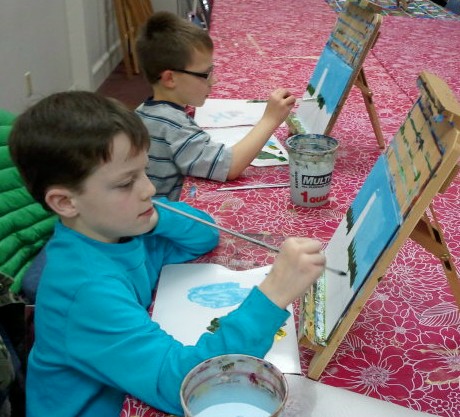
 Here is a great article from the Washington Post by Valerie Strauss from January 2013. Creativity, confidence, problem-solving are just three of the skills listed. Take a second to click here for the rest of this interesting list.
Posted in daily painter | Leave a Comment »

Lincoln looking handsome in a blue sweater

Jed in a Green Crocheted Sweater
Since I started posting photos of my “kids” in their crocheted sweaters I have been asked to post the pattern. The problem has been that I don’t use a pattern. I just crochet and rip out and crochet again until I get it to work. But after encouragement I have written down a pattern for Lincoln’s Sweater. One thing to note is this is for a boy sweater where there is space left open under the belly at the back end to leave room for their pee-pee. Notice on Mamie’s (girls) sweater the sweater is solid all the way to the back. Keep in mind I am not a pattern writer. This is very basic. Make turns at end like you normally would when crocheting.

Mamie’s sweater and my matching hat. Photo by Sandra Patterson.
Lincoln’s Dog Sweater Pattern (Fits a long body dog weight 45 lbs. like Lincoln )
Chain 32.
Row 1: DC in each chain across. (32 DC)
Row 2: Increase DC by 1 DC at each end of row. (34 DC)
Row 3–13: Repeat Row 2 (ending with 56 DC at Row 13)
Row 14: Increase by 2 DC at each end of row. (60 DC)
Row 15: Repeat Row 2 (62 DC)
Row 16: Repeat Row 14 (66 DC)
Row 17-18: DC across with no increase
Row 19: Chain 14 and join with slip stitch to DC. Turn.
Row 20: Sc in each chain and in each DC around. (80 SC)
Row 21: DC in each SC around and slip stitch in beg DC at end of row. (80 DC)
Row 22-33: Chain 3. Turn. DC in each DC around joining with Sl St in beg DC.
Row 34: Turn DC in next 50 DC.
Row 35-36: Turn repeat Row 34.
Row 37: DC across decreasing 1 DC on each end. (48 DC)
Row 38: Repeat Row 37. (46 DC)
Row 39: Chain 18 join to DC with Sl St being careful not to twist chain.
Row 40: Turn. SC in each chain st and in each Dc around. (64 SC)
Row 41: Turn. DC around. (64 DC)
Row 42 – 47: DC in each stitch around decreasing 1 DC on each row. (ending with 58 DC)
Row 48: Turn. SC in each st around.
Row 49: Turn. DC around.
Row 50: Turn. SC around.
Row 51-53: Turn. DC around.
Row 54: Turn. SC around.
Row 55: Turn. DC around.
Row 56: Turn. SC around.
To join the opening and make holes for legs, join yarn to one edge evenly spaced so as to allow 10 stitches. DC 10 stitches across for 5 rows. Leave long piece of yarn when finishing off so you can sew the loose end to the other opening edge. This makes a band under the chest and makes two leg hole openings.
Posted in Crochet | Tagged Crochet, crocheted dog sweater, crocheted dog sweater pattern, dog sweater pattern, Dogs | 28 Comments »

Picasso Painting Sells for $45 million
Yesterday a Pablo Picasso portrait of his mistress, Marie-Therese Walter sold for $45 million. She was often called Picasso’s Muse.
Sotheby’s held an auction of impressionist, modern and surrealist art. The sale was the first of a series held in London this month by Sotheby’s, Christie’s and smaller auction houses. You can read more about the sale here.
You can also click here to read more about Picasso and his love of animals.
Posted in Little Known Facts, Trivia | Tagged Golden Muse, Marie-Therese Walter, Pablo Picasso, Picasso, Sotheby's | Leave a Comment »
 I just read Austin Kleon’s book, “Steal Like An Artist – 10 Things Nobody Told You About Being Creative”. It was GREAT! I encourage everyone to read it. It’s a fast read with lots of tidbits to encourage creativity like my favorite on page 111, “Validation is for Parking”!
As Mr. Kleon’s states on his website, www.austinkleon.com, in describing the book:
“When I was asked to talk to students at a community college in upstate New York, I sat down and wrote a talk based on a list of 10 things I wished I’d heard when I was starting out:
- Steal like an artist.
- Don’t wait until you know who you are to get started.
- Write the book you want to read.
- Use your hands.
- Side projects and hobbies are important.
- The secret: do good work and share it with people.
- Geography is no longer our master.
- Be nice. (The world is a small town.)
- Be boring. (It’s the only way to get work done.)
- Creativity is subtraction.
The text and slides from the talk “rocked the creative world” and went viral—since it’s been online, the original blog post has reached millions of readers. I expanded the post into a book-length work stuffed full of brand-new writing and illustrations, published by Workman Publishing in February 2012.”
It’s worth every penny of the $10.95 cover price. Pick up a copy and take a look for yourself. I highly recommend it.
Posted in Books | Tagged Austin Kleon, Steal Like an Artist | Leave a Comment »


Kids Display Fruit Still Life
We had some great classes last week for adults and kids art. Join us on Wednesday from 10:30-Noon or 5:30 – 7 for Adult Class or on Thursday from 4:15-5:15 for Kids Class or 5:30-7 for Adult Class. Painting is all about the desire to learn. You can paint if you just want to give it a try. Contact me at kwalker@doubledogdesigns.com to learn more. See you in class!
Posted in Art Class | Tagged acrylic, Art Class, art lessons, impressionism, Virginia Artist | Leave a Comment »

Norman Rockwell’s “A Boy and His Dog”

Norman Rockwell’s Triple Self Portrait
Norman Rockwell was born on this day in 1894. He was an American painter and illustrator most well know for his covers on the Saturday Evening Post. In 1916, the 22-year-old Rockwell painted his first cover for The Saturday Evening Post, the magazine considered by Rockwell to be the “greatest show window in America.” Over the next 47 years, another 321 Rockwell covers would appear on the cover of the Post.
Over his lifetime he produced more than 4000 original works of art many now in public collections. Read more about Norman Rockwell here.
Posted in Trivia | Tagged Norman Rockwell | 1 Comment »

mobiles on display

Alexander Calder, untitled mobile, 1976

Posted in Travel, Trivia | Tagged Alexander Calder, Calder, mobiles, National Gallery of Art | Leave a Comment »

Henri Matisse, Odalisque Seated with Arms Raised, Green Striped Chair, oil on canvas, 1923
Every time I go to the National Gallery I see something new even though I must have been there a couple dozen times now. And over the years my taste in art has developed and changed. I am drawn to post impressionism more and more. And Matisse has become a very favorite so I always enjoy seeing his use of color and space. And then I discovered a Gauguin painting of Peonies (my favorite flower) that I had never seen before. What a treat!
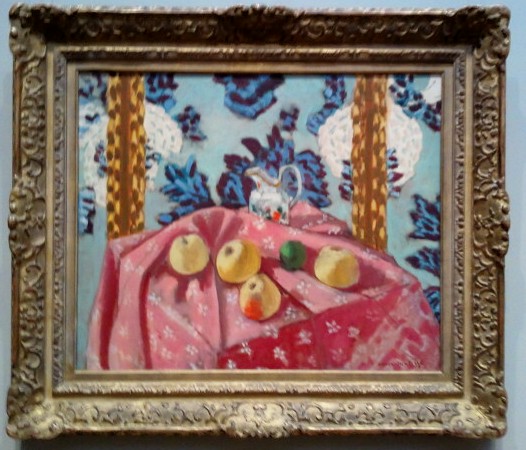
Henri Matisse, Still Life with Apples on a Pink Tablecloth, oil on canvas, 1924

Paul Gauguin, Still Life with Peonies, oil on canvas, 1884
Posted in Travel, Trivia | Tagged Henri Matisse, National Gallery of Art, Paul Gauguin | Leave a Comment »
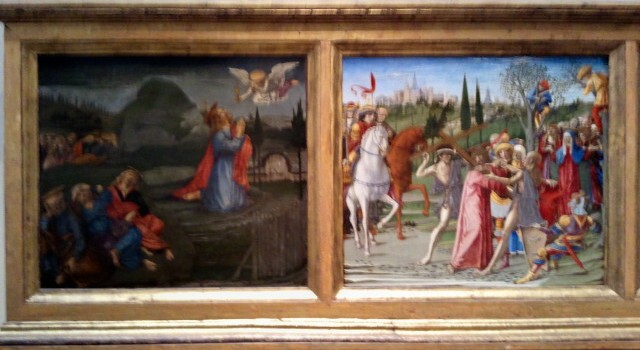
Benvenuto di Giavannis
One fascinating thing I love to see at the National Gallery of Art when I visit is the work they are doing to restore and maintain the beautiful art. Sunday while visiting I ran across this painting group. It was five panels framed together (you see two of them here) that was painted by Benvenuto di Giovanni, an Italian painter (1436-1517) and is a depiction of five scenes in Jesus’ life. The panel on the right is called Christ Carrying the Cross, painted in 1491. It is tempera on panel board measuring around 16″x18″. You can see how much brighter this panel is than the one on the left. The right panel has been removed and cleaned. You can clearly see the difference in the cleaned panel compared to the one that still needs cleaning. What drew me to this grouping was that one of the panels was missing and this sign was in it’s place: It says: “Benvenuto di Giovanni’s Christ in Limbo, usually installed here, is currently in the Painting Conservation Lab for treatment. Each of the five panels in this series will be cleaned in turn.”
How cool is that?
If you want to see “Christ in Limbo”, the piece that is being cleaned, click here.
Posted in Travel, Trivia | Tagged Benvenuto di Giovanni, National Gallery of Art, NGA, Washington DC | Leave a Comment »
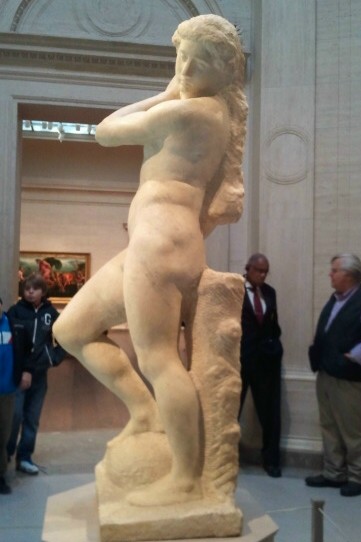
David-Apollo side view

Michelangelo’s David-Apollo
One of the reasons I wanted to get down to the National Gallery this past weekend was to see Michelangelo’s David-Apollo (c. 1530) that is currently on loan from Museo Nazionale del Bargello in Florence until March 3rd. It is a wonderful example of Michelangelo’s work and of his habit of working non-finito (unfinished or incomplete). You can see in the side view the stone left uncut in the back of the sculpture. He leaves much to the viewer’s imagination, wondering what was his intent. You can learn much more by clicking this NGA link.
Posted in Travel, Trivia | Tagged David Apollo, Michelangelo's David-Apollo, National Gallery of Art, NGA, Washington DC | Leave a Comment »
Search This Site
Kelly Walker named Best Local Artist by Northern Virginia Daily for 2013-22!

Check out The Studio on Facebook
-
Contact Info
Sample of Kelly’s Art
 Vineyard 1
 Cookie Jar Painting
 Paper Painting – Walking the Dog

 Palette knife painting done in the afternoon


 One of Allen’s Cats – Bob


 North Fork of Shenandoah River at Sunset I
 Lone Snowman


 Overlook View from Dickey Ridge I
 Overlook View from Dickey Ridge III Shenandoah National Park oil on canvas, 9″x12″ $245
 Overlook from Dickey Ridge II in Plein Air 11″x14″, Oil on Canvas SALE PRICE: $40
 Otis
Otis Lincoln
 Cabin
Cabin
See Kelly’s Art at these locations:
Top Posts & Pages
Click a Catagory to See More
Click a Tag to See More
Abstract abstract art acrylic Art Camp Art Class art lessons barn baseball Beach Blue Ridge Arts Council Capon Springs cat Crochet daily painter daily painting dog Dog Park Dogs embroidery Fall farm animals flag flowers fruit impressionism kids class Landscape Lincoln Matisse MLB Monet National Gallery of Art oil painting painting Paint Party palette knife paper painting pet portrait Pet Portraits pets Plein Air poppies private party QAYG quilt Quilt as You Go Quilting Quilts Rag Quilt Rescue dogs Retreat Rooster Sale sewing sheep Shenandoah River Shenandoah Valley Small Town Life snow snowman still life sunflower sunflowers The Studio The Studio-A Place for Learning Travel tree trees Van Gogh Virginia Virginia Artist Virginia wineries watercolor West Virginia winterArchives
- November 2025
- October 2025
- September 2025
- August 2025
- July 2025
- June 2025
- May 2025
- April 2025
- March 2025
- February 2025
- January 2025
- December 2024
- November 2024
- October 2024
- September 2024
- August 2024
- July 2024
- June 2024
- May 2024
- April 2024
- March 2024
- February 2024
- January 2024
- December 2023
- November 2023
- October 2023
- September 2023
- August 2023
- July 2023
- June 2023
- May 2023
- April 2023
- March 2023
- February 2023
- January 2023
- December 2022
- November 2022
- October 2022
- September 2022
- August 2022
- July 2022
- June 2022
- May 2022
- April 2022
- March 2022
- February 2022
- January 2022
- December 2021
- November 2021
- October 2021
- September 2021
- August 2021
- July 2021
- June 2021
- May 2021
- April 2021
- March 2021
- February 2021
- January 2021
- December 2020
- November 2020
- October 2020
- September 2020
- August 2020
- July 2020
- June 2020
- May 2020
- April 2020
- March 2020
- February 2020
- January 2020
- December 2019
- November 2019
- October 2019
- September 2019
- August 2019
- July 2019
- June 2019
- May 2019
- April 2019
- March 2019
- February 2019
- January 2019
- December 2018
- November 2018
- October 2018
- September 2018
- August 2018
- July 2018
- June 2018
- May 2018
- April 2018
- March 2018
- February 2018
- January 2018
- December 2017
- November 2017
- October 2017
- September 2017
- August 2017
- July 2017
- June 2017
- May 2017
- April 2017
- March 2017
- February 2017
- January 2017
- December 2016
- November 2016
- October 2016
- September 2016
- August 2016
- July 2016
- June 2016
- May 2016
- April 2016
- March 2016
- February 2016
- January 2016
- December 2015
- November 2015
- October 2015
- September 2015
- August 2015
- July 2015
- June 2015
- May 2015
- April 2015
- March 2015
- February 2015
- January 2015
- December 2014
- November 2014
- October 2014
- September 2014
- August 2014
- July 2014
- June 2014
- May 2014
- April 2014
- March 2014
- February 2014
- January 2014
- December 2013
- November 2013
- October 2013
- September 2013
- August 2013
- July 2013
- June 2013
- May 2013
- April 2013
- March 2013
- February 2013
- January 2013
- December 2012
- November 2012
- October 2012
- September 2012
- August 2012
- July 2012
- June 2012
- May 2012
- April 2012
- March 2012
- February 2012
- January 2012
- December 2011
- November 2011
- October 2011
- September 2011
- August 2011
- July 2011
- June 2011
- May 2011
- April 2011
- March 2011
- February 2011
- January 2011
- December 2010
- November 2010
- October 2010
- September 2010
- August 2010
- July 2010
- June 2010
- May 2010
- April 2010
- March 2010
- February 2010
- January 2010
- December 2009
- November 2009
- October 2009
- September 2009
- August 2009
- July 2009
- June 2009
- May 2009
The Studio Events & Location


 The Studio